




|
Getting your Trinity Audio player ready...
|
I recently ran a LinkedIn survey asking leaders to choose their top three must-haves in their next role. The options were: work-life balance, a great boss, an ideal location, great money, mission or purpose-driven work, promotional opportunities and the flexibility to work from home.
The winners might surprise you.
But before the big reveal, I want to point out an important truth: the job market isn’t what it was even a few years ago. Between ongoing economic volatility, uneven hiring trends and global uncertainty, many executives are finding themselves evaluating opportunities that aren’t as good as the roles they previously held – whether in title, scope or compensation. If that’s you, you’re not alone.
My survey, then, wasn’t about identifying the ideal top three must-haves in your next role, but about a more important question for today’s job market: how you determine what you really want when you’re being forced to make concessions.
This article was originally published by Sarah Johnston, founder of Briefcase Coach and has been republished with permission.
What the data showed
The leader board
The top two selections, by a wide margin, were work-life balance and having a great boss, followed by flexibility in how and where work gets done.
What stands out to me about this ranking is what these priorities represent. Executives aren’t just optimizing for “more” anymore; they’re optimizing for sustainability and they’re recognizing that doing so is a form of managing risk.
In this data, I see a trend away from high burnout roles and company cultures. This is supported by an Oliver Wyman study, which identified more flexibility and better work-life balance as among the top three reasons employees leave jobs.
Having a sustainable job is also a form of risk mitigation. A bad boss isn’t just frustrating, they can derail your trajectory, limit your visibility and impact your long-term earning potential. Poor work-life balance isn’t just inconvenient; it leads to burnout, which affects performance, decision-making and ultimately your ability to stay and succeed in a role. Lack of flexibility doesn’t just create friction; it can make a role fundamentally incompatible with your life, especially as personal responsibilities evolve.
In other words, leaders don’t see these characteristics as “nice-to-haves” that they can learn to live without, but as structural factors that determine whether a role is viable over time.
What fell to the bottom
Equally telling was what didn’t top the list. Compared to these day-to-day experience factors, priorities tied to future upside, like compensation and promotional opportunities, ranked noticeably lower.
This might surprise you, especially for a group of high-performing, growth-oriented professionals. But this doesn’t mean these factors weren’t part of the equation. It means that many executives are no longer willing to pursue growth at any cost.
They’re prioritizing the conditions that make growth sustainable, rather than chasing the next title or pay raise in an environment that may not support their long-term success. They may also be assuming that in finding roles where the fundamentals – leadership, structure and day-to-day experience – are present, that growth will follow because the conditions are right.
You’re not accepting a job, you’re accepting a collection of tradeoffs
How to determine your own tradeoffs
While my survey revealed that executives are prioritizing day-to-day sustainability over pure, future-focused upside, the most important question is what that means for you.
Because knowing what matters to others is one thing. Deciding what you’re willing to trade off in a real-life job offer scenario is something else.
This is where I see many executives get stuck. They’re no longer evaluating near-perfect roles that offer them almost everything they want; they’re choosing between different combinations of tradeoffs. And without a clear decision framework, it’s easy to default to either taking the first viable option out of pressure, or holding out indefinitely for something that may not materialize.
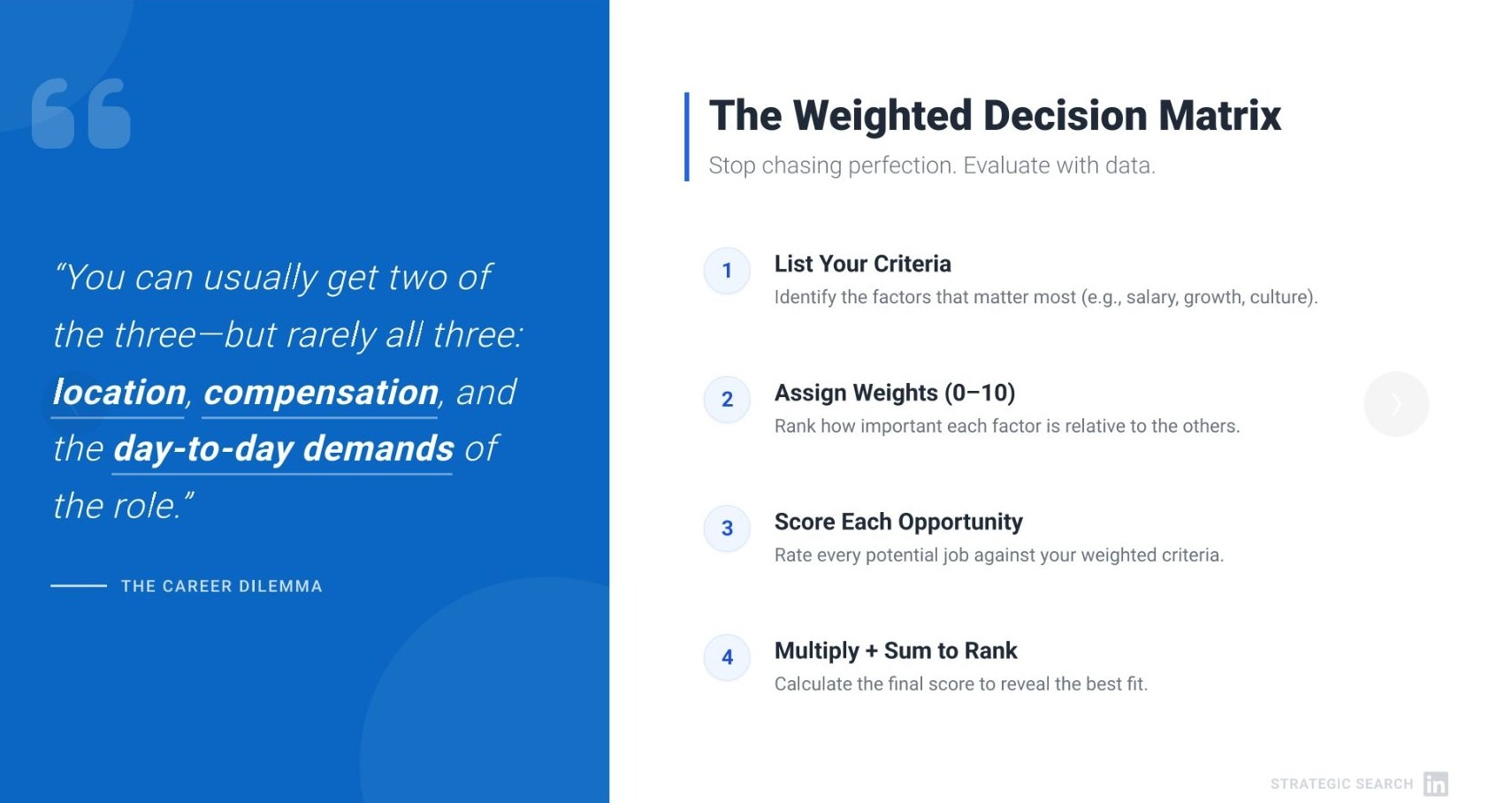
The shift I encourage is to stop looking for the “perfect” role and start thinking in terms of intentional tradeoffs. I put together a framework to help with exactly this.
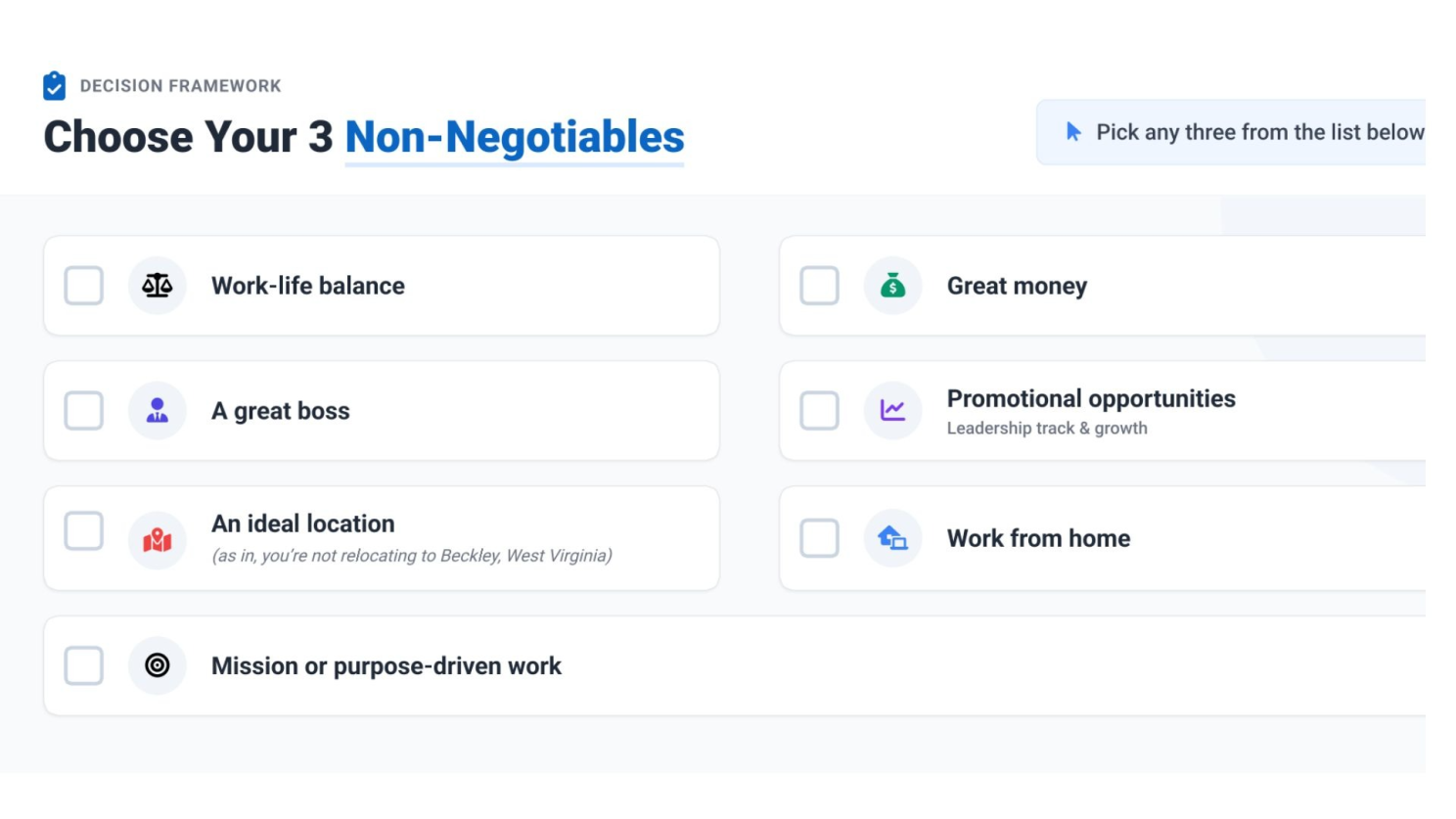
A simple place to start is identifying your three non-negotiables, or the factors that directly impact your personal ability to perform, sustain and succeed in a role. Once those are clear, everything else becomes a variable. Not irrelevant, but flexible.
Then comes the strategic evaluation, because not all tradeoffs are created equal. Some are reversible – compensation can grow, titles can evolve and even work location or work-from-home options can change over time.
Others are much harder to unwind, like a misaligned boss, a leadership team that doesn’t support you or a culture that leads to burnout. They’re not short-term inconveniences, but factors that can limit your trajectory, impede your performance and make it difficult to recover momentum.
So, when you’re evaluating your next move, don’t just ask, “What do I want more of?” Ask also, “What am I not willing to risk?”
That shift is what allows you to make decisions that aren’t just reactive to the market, but aligned with where you want your career to go next.
You’re not accepting a job, you’re accepting a collection of tradeoffs
The secret that strategic job seekers know is that, at the executive level, every role is a collection of tradeoffs.
Especially in this job market, it’s unlikely you’ll encounter a unicorn role that delivers everything – optimized compensation, unlimited growth, great leadership, the ideal location, full flexibility and meaningful work.
This means that the real decision isn’t, “Is this the right role for me?” but “Is this the right set of tradeoffs for me right now?”
The most successful executives seeking a job change don’t spend their time chasing an ideal role before making a move; they focus on establishing their non-negotiables and making intentional decisions. Because the goal isn’t to avoid tradeoffs, it’s to choose the ones that align with your priorities, allow you to flourish in the moment and position you for what comes next.