




|
Getting your Trinity Audio player ready...
|
A client arrives with a screenshot. Someone in a Facebook group wrote that pharmacy technicians make $30 an hour and she has found a six-month online course. She wants to know which intake to choose. (This is a composite of a common conversation, not a real client.)
Before talking about intakes, it is worth spending 15 minutes together on Job Bank, the Government of Canada’s site for jobs and labour market information (LMI). When Steven Tobin of the Labour Market Information Council (LMIC) wrote for CareerWise in 2019, he noted that LMIC research found social media had become one of the top sources of LMI, and that more than half of the career practitioners LMIC surveyed found the LMI they need difficult to find. The four checks below turn a number from a post into a decision a client can explain. They work in any province; the examples use Alberta, where Job Bank publishes figures for eight economic regions.
One piece of background helps. Job Bank organizes occupations by the National Occupational Classification (NOC). The 2021 version replaced the old skill levels with six categories for Training, Education, Experience and Responsibilities (TEER), numbered 0 to 5 and shown as the second digit of each five-digit code. A lower TEER number usually means a longer formal pathway.
Check 1: Match the duties to the right occupation group
Search Job Bank for the title the client has in mind, then read the duties rather than the title. In our example, one title family splits in two. Pharmacy assistants and pharmacy technical assistants are NOC 33103 (TEER 3). Pharmacy technicians are NOC 32124 (TEER 2), a regulated occupation.
Job Bank says pharmacy technicians usually need a two-year pharmacy technician college program, must complete the Pharmacy Examining Board of Canada (PEBC) certification exams and must register with a regulatory body in every province except Quebec. Pharmacy assistants usually need a college program of six to 12 months, or secondary school and several months of on-the-job training. The figure in the post, if it belongs anywhere, belongs to pharmacy technicians, and the six-month course leads to pharmacy assistant roles.
Check 2: Read the range, and check where a regional number comes from
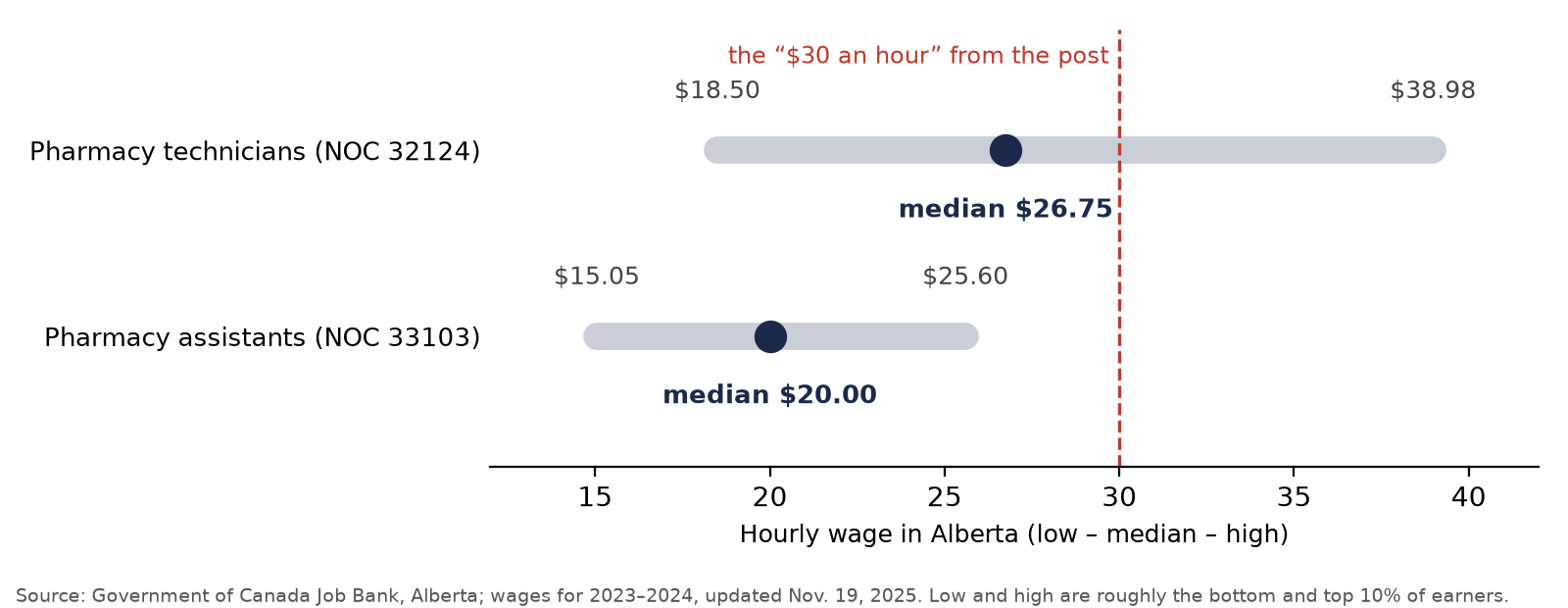
Each wage page shows a low, a median and a high; the low and high are roughly the bottom and top 10% of earners. For Alberta, Job Bank lists pharmacy assistants at $15.05, $20.00 and $25.60 an hour, and pharmacy technicians at $18.50, $26.75 and $38.98 (data for 2023-2024, updated Nov. 19, 2025). Even the technicians’ median sits below $30. Reaching the top of a range usually reflects experience, hours or the employer.
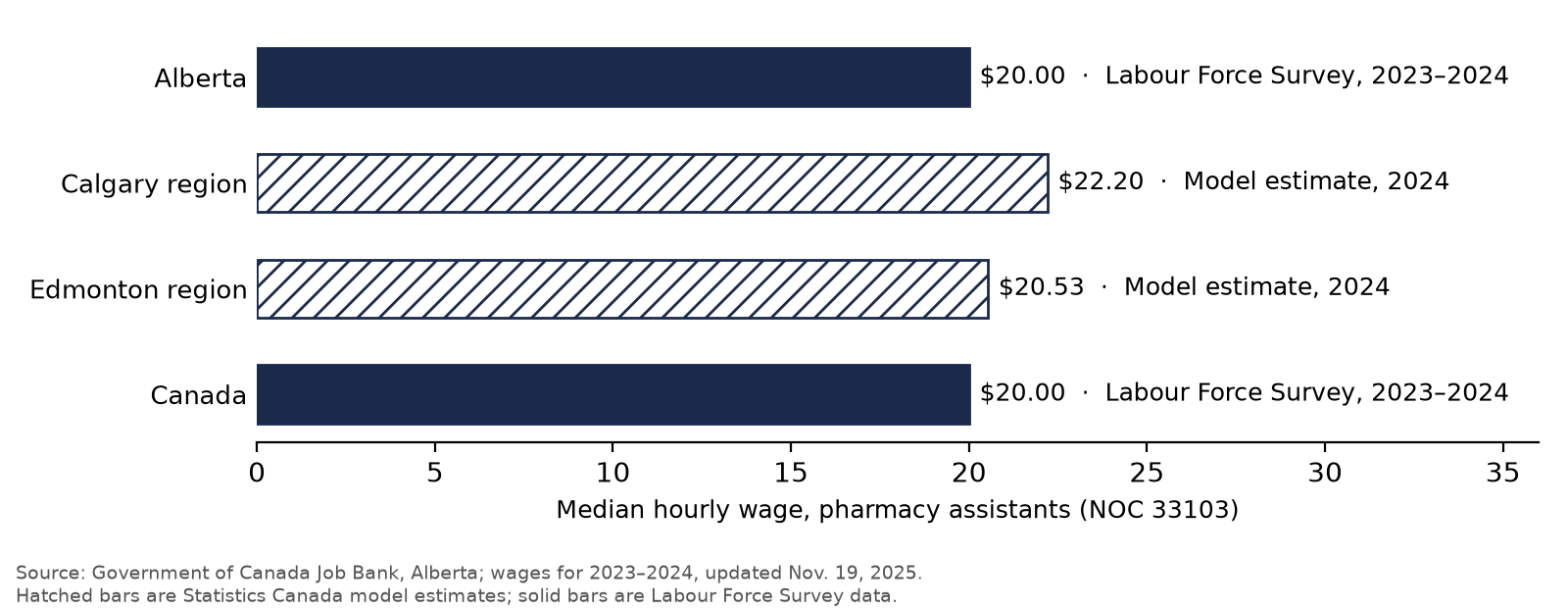
Regional rows deserve a second look. Job Bank shows a pharmacy assistant median of $22.20 for the Calgary region and $20.53 for the Edmonton region, both above the provincial $20.00. But those regional figures are Statistics Canada model estimates for 2024, while the provincial row comes from the Labour Force Survey for 2023-2024. The source line under each row says which is which. Compare like with like, and treat a gap between a model estimate and a survey figure as a prompt to dig, not as a finding.
Check 3: Read the outlook as a regional rating, not a personal forecast
Job Bank rates the 2025 – 2027 outlook for pharmacy technicians in Alberta as Good: Very good in five regions, Good in Calgary and Edmonton, and Undetermined in Wood Buffalo-Cold Lake. Pharmacy assistants are rated Moderate in every Alberta region (outlooks updated Dec. 10, 2025). The same occupation can be rated differently in another province, so check the province where the client will look for work.
The reasons listed under each rating matter as much as the label. For both groups, Job Bank expects few openings from retirements, so most openings come from growth. An outlook describes the balance of jobs and job seekers in a region over three years. It does not tell anyone how long their own search will take.
Check 4: Compare the usual requirements with what the program delivers
Put the Requirements tab next to the program outline. A six-month course can match what Job Bank lists for pharmacy assistants; it does not match the two-year program and PEBC exams listed for pharmacy technicians. The occupation size is worth a glance too: about 4,100 pharmacy assistants and 2,600 pharmacy technicians work in Alberta, most of them in retail stores (84% and 56%), with hospitals the next largest employer.
Instead of judging a provider for the client, it helps to give them questions they can put to any school:
- Which NOC group does this program prepare me for, and does it meet that group’s usual requirements on Job Bank?
- Where does the wage figure in your materials come from: which occupation, region and year?
- Does the program include the supervised practice or exam preparation the occupation requires?
- If I study part time, how long will it realistically take?
From which intake? to which pathway?
In our composite example, the client may still choose pharmacy work. But she now knows that the six-month course leads to assistant roles with a Moderate outlook, that the technician pathway takes about two years and a licensing exam, and that the $30 figure was neither a median nor her starting point. The numbers changed the question, which is what good LMI is for.