




|
Getting your Trinity Audio player ready...
|
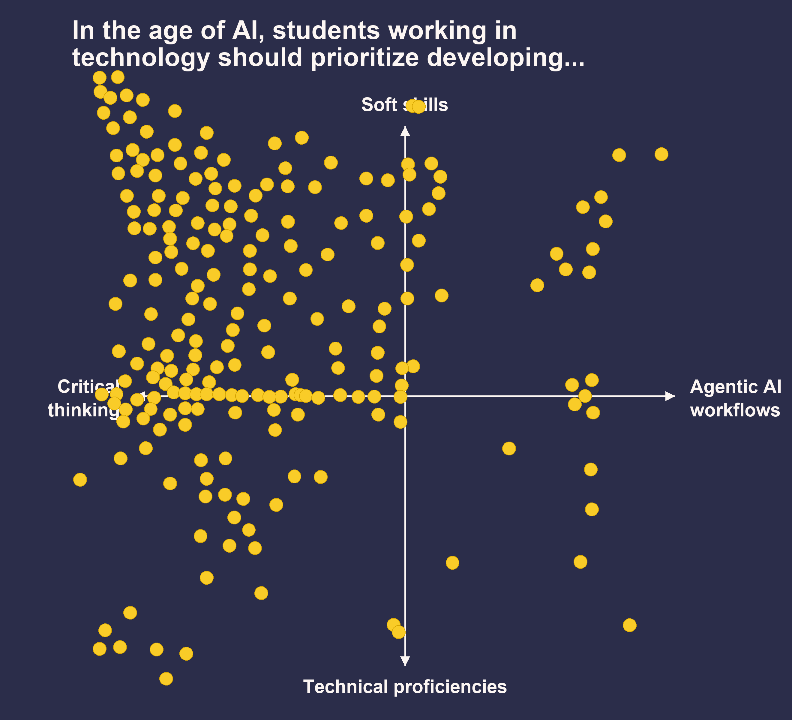
At Web Summit Vancouver 2026, a conference primarily attended by tech leaders, an interactive poll asked what students working in tech should prioritize developing in the age of artificial intelligence (AI).
Surprisingly, at a conference filled with people who take pride in their technical expertise, votes clustered around critical thinking and soft skills rather than technical proficiency and AI tools.
Indeed’s survey of Canadian employers reinforces the point: employers rate traits like critical thinking and working well with others higher than expertise like technical skills and education.
Navigating a shrinking entry-level job market
AI has caused a seismic shift in the workplace. AI can now do much of the work employers have historically hired junior staff to do. At the same time, Canadian vacancies requiring less than one year of experience fell across every occupational group in 2025, according to the C.D. Howe Institute. For new jobseekers, especially knowledge workers, it’s a trying time.
Unfortunately, despite what employers are looking for nowadays, it is easy for a new jobseeker to fall into the trap of pointing to degrees, achievements and technical proficiencies when applying for jobs. With little or no workplace experience, they may struggle to recognize their value beyond qualifications, let alone articulate and prove it.
Looking beyond career assessments to identify candidate value
Assessments, such as CliftonStrengths and the Myers-Briggs Type Indicator (MBTI), make it easy to identify strengths, but labels alone say little about a person’s value.
Various frameworks, such as RVEAL’s career alignment framework, Renzulli’s rings of giftedness and Kernbach and Eppler’s Opportunity Bingo, converge on the idea that a person stands out at the intersection of skills, interests and strengths.
Discovering one’s giftedness can take years of trial-and-error job hopping. But it doesn’t have to take a lifetime to discover where you stand out. Even someone with no work experience has years of real-life evidence to reflect on.
A 5-step exercise to help new jobseekers stand out
Two issues generally stand in the way of new jobseekers landing the right opportunities: searching too narrowly and not recognizing what makes them an outstanding candidate. The following exercise helps with both:
- Make 3 short lists: List the person’s skills, subjects or causes of interest, and strengths that describe how they tend to work with others or approach a task.
- Create randomized combinations: Pick 1 item from each list at random and write down the result. Random selection helps explore possibilities they might not otherwise consider. An online random number picker can help remove bias. Create 3 to 5 combinations.
- Sketch possible roles: For each combination, ask the person to imagine the kind of organization, the high-level type of work they might do there and how that work fits with the team’s objectives. Help them come up with roles to investigate, rather than listing responsibilities.
- Compare the roles with real postings: Search through postings together, starting in the person’s field as usual and adding keywords suggested by a combination. Assess the role in its context rather than seeking exact keyword matches. Discuss non-negotiables such as location, pay and company culture. A role needs to meet the jobseeker’s essential conditions, however appealing the work sounds.
- Build the case for a potential role: When a posting appears promising, ask for several examples from school, volunteering, sports or work that show relevant skills, interests or strengths. Use all entries from step 1, including uncircled entries. Together, choose the strongest few and identify how each relates to the role.
Case study: A recent graduate
Imagine a recent graduate who earned a bachelor’s degree in commerce, majoring in marketing. Their starting point is to search for marketing assistant roles. Ask them about coursework, interests and student activities to build the three lists:
- Skills: copywriting, market research, campaign planning, event planning, data analysis, presentations, budgeting
- Interests: music, travel, sustainability, fitness, food, animal welfare
- Strengths: exploratory, relational, empathy, harmony, structured
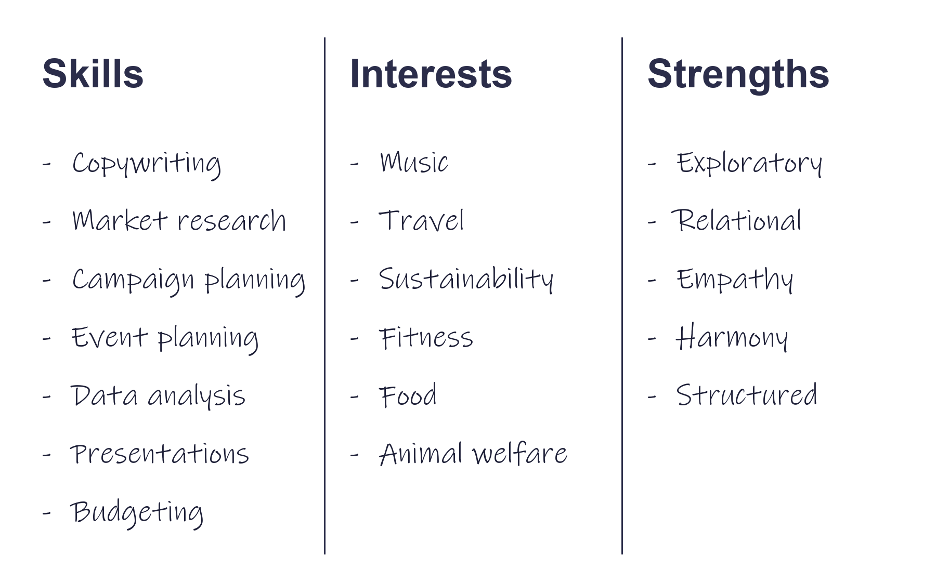
Next, draw three combinations at random. Give each one equal consideration.
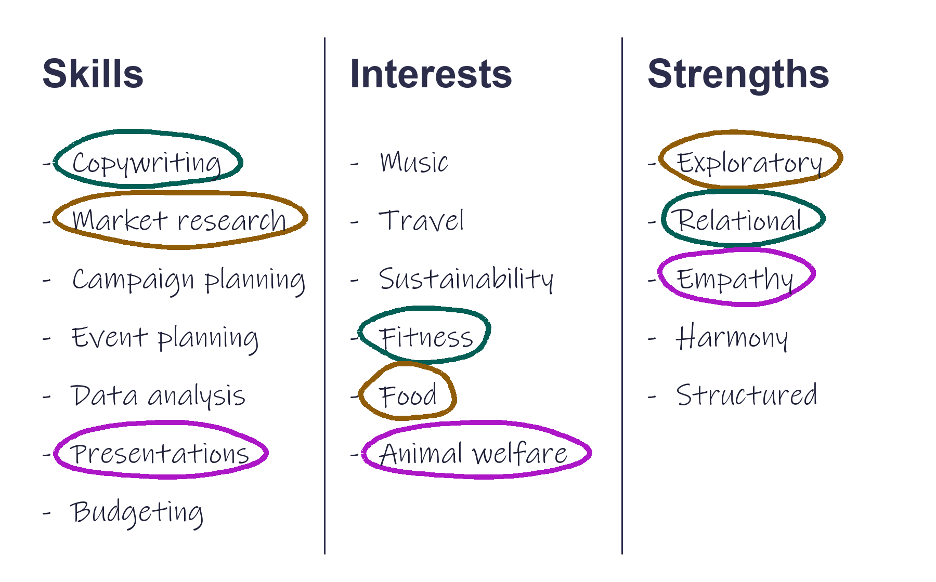
Step 3: Before searching for job postings, discuss where each combination might add value in the workplace. Together, sketch possible roles for each skill-interest-strength combination:
- Copywriting + Fitness + Relational: Fitness club marketing and member engagement, using writing and communication to attract new members and keep existing members engaged.
- Presentations + Animal welfare + Empathy: Outreach for an animal shelter, explaining adoption programs at community events and answering prospective adopters’ questions.
- Market research + Food + Exploratory: Customer research for a food business, exploring what customers want and helping the business spot new opportunities.
Now search for real job postings that align with these combinations. Taking the first combination as an example, search for marketing roles alongside keywords like “fitness club.”
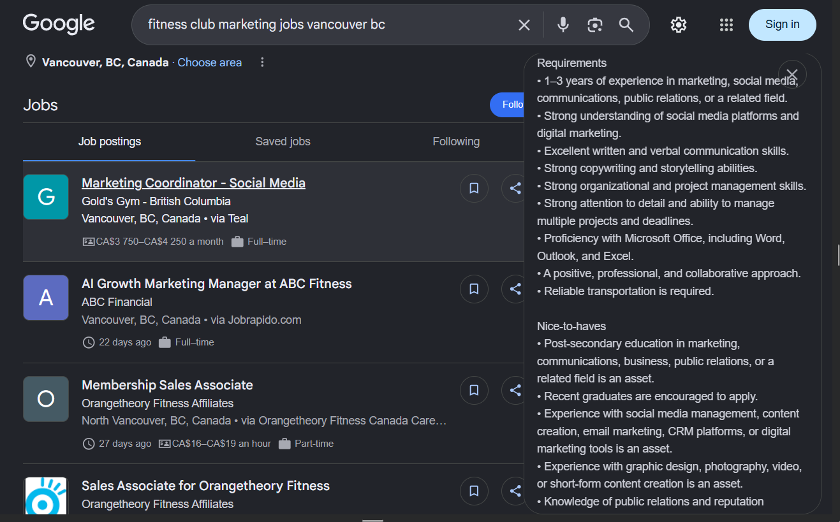
Say you find a local gym posting for a social media marketing co-ordinator. The description includes creating member-focused content and community interaction, which aligns with the Copywriting + Fitness + Relational combination. The jobseeker also has social media skills and finds the location and pay acceptable, giving them a promising opportunity to show what sets them apart.
Finally, build a case for the role. Ask the candidate for relevant examples. The jobseeker recalls volunteering for the campus running club, where they helped write posts about group runs and answer members’ questions. They also helped organize a student music night, co-ordinating performers and volunteers and keeping the schedule on track. Together, compare the examples with the posting’s responsibilities.
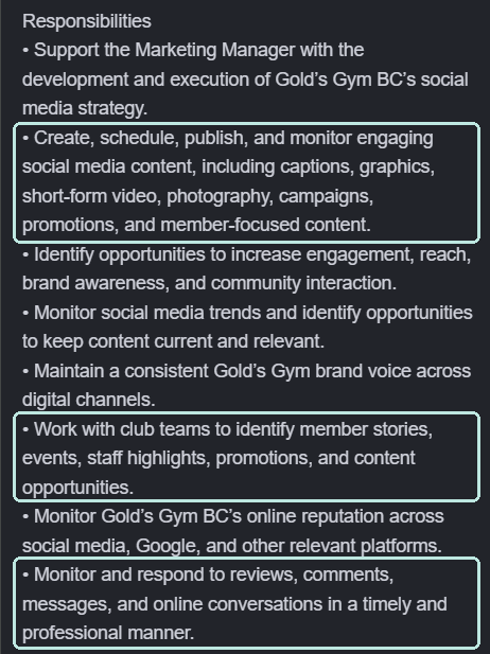
The running club work connects Copywriting + Fitness + Relational to the posting’s content and member-response duties. The music night draws on event planning and a structured approach from the original lists. Co-ordinating performers and volunteers shows their organizing skills, relevant to the posting’s requirement to work with club teams on events and promotions. Both experiences help the jobseeker make a strong case for this role.
Preparing candidates to answer ‘Why hire me?’
While entering today’s workforce can feel daunting for new jobseekers, they already possess the experiences needed to prove their value. This exercise provides a simple framework to uncover it. By exploring the intersection of skills, interests and strengths, career professionals can help candidates explore job postings more broadly and discover roles uniquely suited to them. It also equips them with concrete, personal examples that bridge the gap between who they are and the employer’s needs, empowering them to answer “Why hire me?” with clarity and confidence.