




|
Getting your Trinity Audio player ready...
|
Creative Presence is a way of being when working with others that is tuned in, imaginative, and responsive in the moment, inviting new perspectives, discovering hidden meaning, and creating space for possibilities to emerge.
This article was originally published on Doubleknot Works and has been republished with permission.
I have spent my lifetime studying, exploring, and developing creativity as a skill across a range of contexts, and am highly aware of its importance when engaging in coaching conversations, particularly in moments of liminality. These moments of uncertainty can be challenging, and in our rush to respond, it may be tempting to retreat to the familiar, offer unnecessary advice, or even freeze altogether. When entering liminality with creative presence, this way of being allows us to develop a partnership, trusting that together, we will find our way through and respond to what emerges in conversation in an act of shared creativity.
The World Economic Forum has identified creativity as one of the top skills needed for workforce development in the Future of Jobs Report. From an intervention-based perspective, creativity can be put into action in work with participants through tools such as metaphor, card sorts, drawing, and physical movement. All of these creative approaches are very useful tools for coaches to put into practice, but the impact and strength of the work with participants throughout coaching sessions can have significantly more impact when we are not only implementing tools or interventions, but are doing so with an awareness of how we are present within the session.
This turns our attention to the development of creative presence, which helps cultivate creativity skills beyond the act of doing by emphasizing creativity as a way of being when working with others. When tools (or interventions) are used by someone who is activating their creative presence, the impact significantly increases. When no tools are in use, creative presence remains an essential element of the conversation, creating a space for emergent learning and transformation. Creative presence is tuned in, imaginative, and responsive, in the moment. It creates space for new perspectives and the discovery of meaning, allowing new possibilities to emerge.
The Creative Presence model
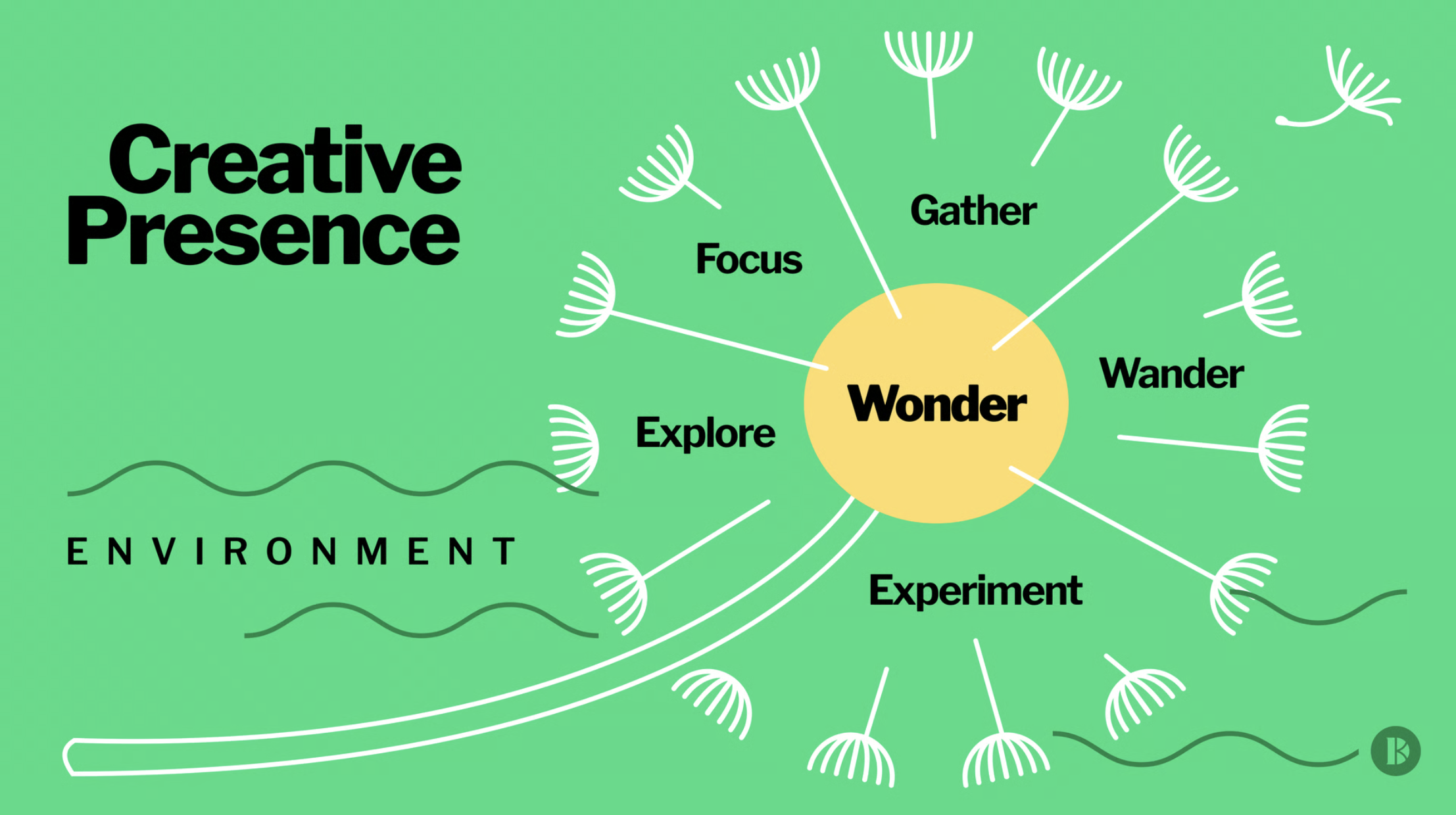
The Creative Presence model © 2026 Andrea Fruhling, Doubleknot Works
Creative presence can be understood and developed through five practices: Explore, Focus, Gather, Wander, and Experiment. At the core of these practices is the element of Wonder, with special attention also being paid to the Environment. Understanding and growing creative presence is a lifelong practice that requires patience, dedication, and an openness to learn new things. When we actively practice creativity, research has shown that positive emotions are generated, and negative emotions are faced more easily as they arise. This model can be interpreted and applied in a number of different contexts. This model can inform and support helping roles such as coaches, counsellors, and mentors in their work supporting others, while simultaneously providing an understanding and practice for personal creative development, which in turn can influence and strengthen one’s ability to be creatively present.
The Creative Presence model is depicted as a dandelion. With Wonder at the center, it is the starting point and constant throughout. The practices surround and connect to the center (Wonder) and can be practiced on their own, while also working in relationship to one another. Surrounding the dandelion is the environment. The environment (like the wind) flows in two directions. One’s environment can directly impact one’s ability to be creatively present, and we can also influence the creative presence of those around us. The dandelion flower (on the Pacific coast of Canada) is known as a weed, and something we work to remove. However, when a dandelion is discovered in full bloom (often by a child), it is joyfully picked and blown, providing a sense of wonder even as we watch the seeds float away. The dandelion was created so that it can spread its seeds using the environment (the wind). Creative presence is a relationship-based way of being that is activated when shared, planting seeds of creativity as they land, continuing to grow.
Here is an overview of the practices and elements that, when put into practice, will strengthen one’s ability to be creatively present (visit doubleknot.works/blog for a full description of each practice).
Wonder
A state of attentiveness and awe when something becomes a source of inspiration, moving us beyond certainty into a posture of openness that slows judgment and creates space for deeper meaning and possibility to emerge.
Explore
A genuine interest and pursuit of new knowledge, experiences, and possibilities in order to develop deeper insights, imaginative thinking, and generative dialogue.
Focus
A sustained awareness that provides clarity in relation to a specific topic, with an identified direction while remaining open to what might emerge.
Gather
The practice of discovering and collecting information about ideas and themes that have drawn your attention. This is done with an openness to deepen learning, meaning-making, and the possibilities that can emerge through combinatory thinking.
Wander
The intentional practice of pausing by slowing or stepping back from goal-oriented thinking in order to allow your attention to drift, and notice new possibilities without constraint, immediate judgment of ideas or direction.
Experiment
An intentional and often courageous act of experimenting with new approaches, questions, or ideas. This creates space for discovering insights by expanding possibilities without fear of failure.
Environment
As an inherently relational act, creative presence can be developed and refined independently, but it is a way of being in response to the environment.
Conclusion
As creative practices are revisited and strengthened, learning deepens, and actions connected to practice become increasingly personalized as you get to know your creative self. Developing new habits and ways of engaging in creative practice throughout your life will help you build your confidence and increase your sense of hope. You will discover new ways to strengthen your creativity and share your creative presence with those you support, combining your creativity with theirs to create something new together.
Andrea Fruhling is the Director of Doubleknot Works and co-author of Career Wayfinder: Discovering Your Career Through Delightfully Practical Projects. She is a Professional Certified Organizational Coach (International Coaching Federation), and an Instructor for the University of British Columbia’s internationally award-winning Organizational Coaching certification program. Andrea developed and leads the Career Coaching Practitioner course (UBC Extended Learning) and is a certified expert trainer in the Hope-Action Theory.