




|
Getting your Trinity Audio player ready...
|
Career practitioners are increasingly aware of neurodiversity and strategies to support neurodiverse clients, but is dyslexia sufficiently part of this conversation? While statistics vary, Dyslexia Canada estimates that up to 20% of Canadians fall under the dyslexia umbrella.
Dyslexia is not simply seeing letters and numbers backwards, nor is it the inability to read – though this experience may apply to some individuals. It is a different way of organizing and processing information.
Many people with dyslexia prefer to think and learn in pictures and forms – rather than written or spoken words. Dyslexic learners are often three-dimensional thinkers who can envision ideas as forms they picture in their minds, like a cartoon thought bubble. Those without dyslexia may prefer to think in terms of language and words spoken aloud or written on a two-dimensional page.
Put simply, many people with dyslexia understand and organize ideas best in terms of visual forms, while many others who do not experience dyslexia may think and learn best using written and spoken language.
How do I know this? My perspective comes from within. I am dyslexic, and as an educator and career counsellor, I would like to share seven techniques to support your clients. The good news is, what works best for those with a dyslexic brain can often work well for all clients.
1. Relationship-building and trust
Clients may arrive at your door without a formal diagnosis. Building that trusting relationship is vital as it allows for honest conversations about previous challenges at school and work. Follow your client’s lead and ask what may be helpful as you consider the following suggestions, recognizing that while a diagnosis by a psychologist is often necessary for accommodations at school and work, no harm will be done if you implement these strategies with a client who self-identifies as having reading challenges.
2. Self-confidence and systemic challenges
The traditional school system can be a challenging place for the dyslexic learner, as most classrooms focus on learning by reading and demonstrating knowledge through writing. You may be the first person to suggest to your client that there is an upside to dyslexia, such as the ability to think innovatively, strong visual-spatial skills, and big-picture thinking.
Familiarize yourself with dyslexia resources and brainstorm ways clients can use their strengths in future careers. When possible, connect clients with school-based supports so those attending training are set up for success – using technological and other supports that can maximize learning.
3. Resume writing and other documentation
Clients with dyslexia may find it difficult to organize written information. Scheduling the appointment as an opportunity to write together can be more effective than sharing instructions and having the client complete tasks on their own.
4. Disclosing information to employers
Some clients seek advice about whether to disclose their dyslexia to an employer. While some industries will be more supportive than others, one consideration would be to disclose dyslexia after being hired for a job if parts of that job are likely to be affected.
5. Formalized online assessment tools
Many career professionals use a variety of online assessment tools to support career decision-making, like the MBTI and the STRONG. Ask your clients how comfortable they are completing assessments that require reading, and provide options such as oral testing and paper-based self-assessments that you can complete together for those who are less comfortable reading on their own.
6. Using card sorts
Card sorts such as the Values Card Sort provide information about a client’s values as they relate to career options and can be visually appealing to those with dyslexia. Ask your client what they prefer – for you to read each card aloud before handing it over – or for the client to do this on their own. Again, follow their lead.
7. Organizing next steps
You may also assist your clients in the pursuit of educational goals – whether that includes adult basic education or post-secondary training. Some clients appear to spin their tires when it comes to following through on necessary next steps. Often, this is not lack of commitment – but simply a different way of organizing information that makes paperwork and multi-step written instructions challenging. Here are some suggestions you may want to try:
- Recipe cards – Borrowing from the Narrative Career Counselling approach, which encourages the use of co-written notes, provide your clients with a recipe card that identifies agreed-upon steps so that once your client leaves your office, they have a record of what needs to be done before seeing you again. Use few words, lots of white space and essential information needed to accomplish each step.
- Multi-step plans – For multi-step plans, such as applying to schools, student loans and scholarships – help your clients chunk each process into simplified steps and keep a list of action items. This can be scanned at the end of the appointment and entered into client notes so that there is a running record of agreed-upon actions.
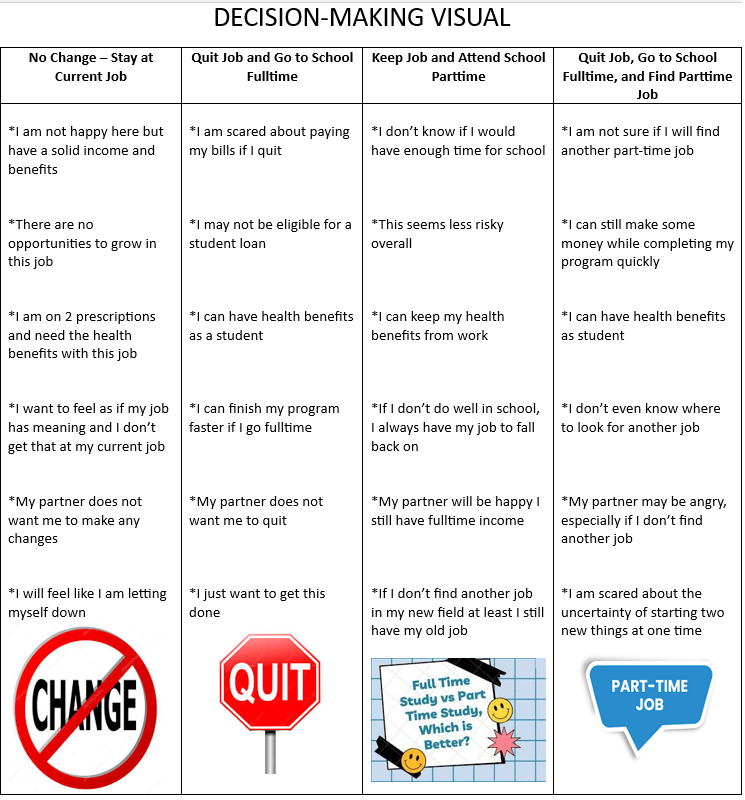
- Visual decision–making – Many people with dyslexia are big-picture thinkers who benefit from visualizing multiple options. Once you have identified options (e.g. stay in same job, quit and go to school, keep working and attend school part-time) it is helpful to create a visual image. Divide your paper in three or four columns, identify each option at the top of each column and list important details underneath. Use as few words as possible and make sure the sections of the page are well divided.
Years ago, left-handedness was identified as a deficit that needed correction. Today, we simply have left-handed scissors and fridge doors.
While we continue to list dyslexia under the category of Specific Learning Disabilities in the DSM–5, it is my hope that we will soon recognize these differences as problematic only when the environment is rigid and geared toward those with more typical brains.
For now, we can do our best as career counsellors and practitioners to support these differences with compassion and encouragement – providing tools and approaches that are more in line with this holistic, creative and imaginative way of being in the world. After all, it is often the imagination of those with a dyslexic brain that has contributed to humanity’s greatest achievements.